



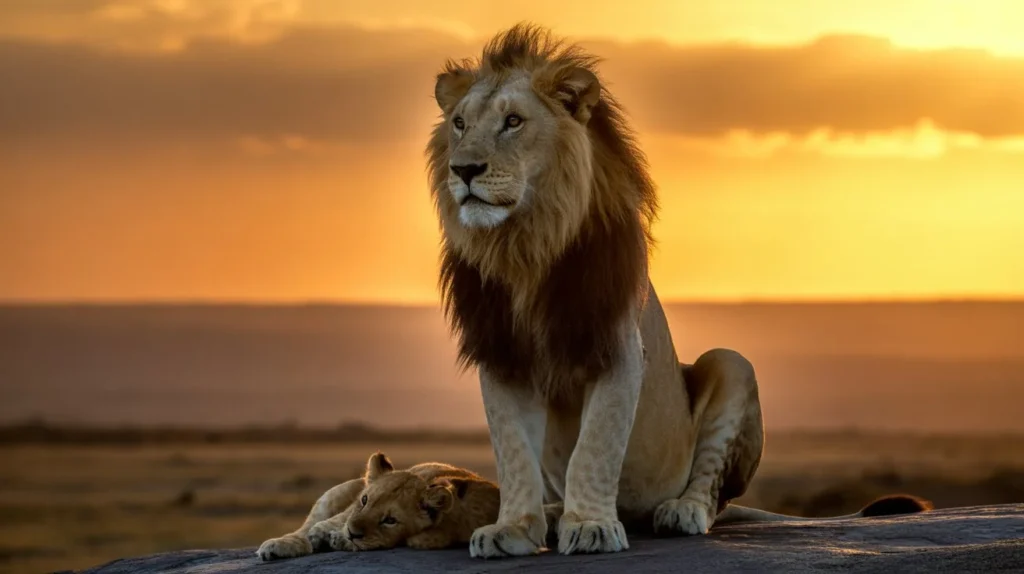
“The lion father may not hold his cubs in the way we expect — but his roar is the first wall standing between them and death.”
When visitors on an African safari spot a male lion resting in the golden grass of the Serengeti or the Maasai Mara, they often wonder: is this magnificent creature as devoted to his family as he is to his territory?
The question are male lions good fathers? is one of the most fascinating in wildlife biology, and the answer is far more nuanced than the popular image of a lazy, mane-tossing king suggests. Understanding male lion paternal behaviour requires us to look beyond human definitions of fatherhood and into the complex social ecosystem of the African pride
Understanding the Lion Pride: The Foundation of Fatherhood
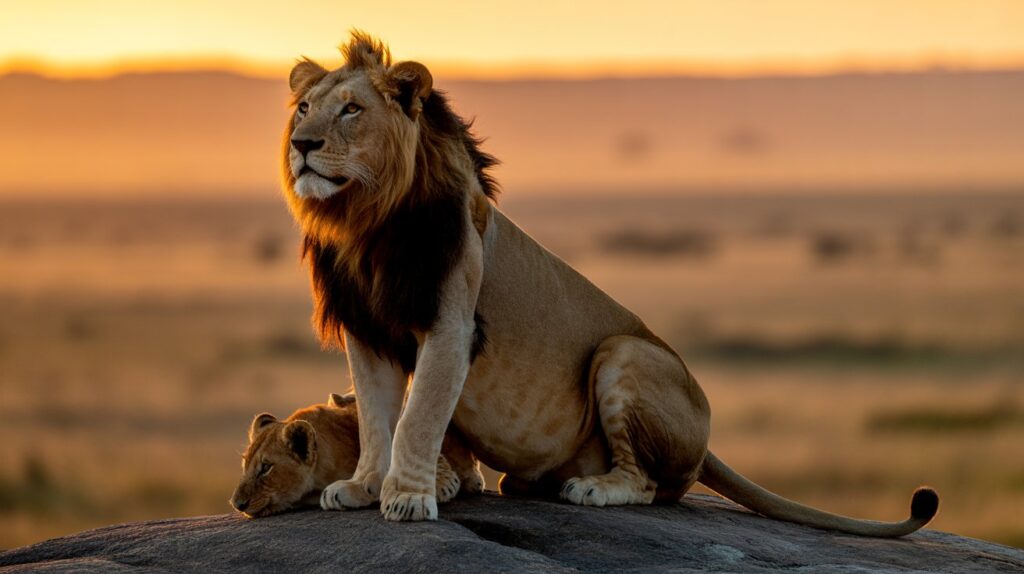
A typical lion pride consists of 6 to 10 related lionesses, their dependent cubs, and a coalition of 2 to 3 adult males often brothers or companions who have bonded since youth. This coalition structure is not incidental; it is the backbone of cub survival. Resident males are, as research from the University of Minnesota’s Lion Center confirms, the fathers of virtually all cubs sired during their tenure in a pride.
Male lions do not raise cubs in the hands-on mammalian sense they do not carry, nurse, or teach cubs to hunt. But this doesn’t mean they are absent fathers. Their role is architectural: they build and maintain the conditions under which cubs can survive at all.
The Most Critical Job: Protection Against Infanticide
Perhaps the single most important thing a male lion does for his offspring is something visitors rarely witness the constant, vigilant patrol of pride territory that keeps rival males away.
When a new male coalition takes over a pride, one of the most brutal realities of the African bush unfolds: incoming males kill all dependent cubs sired by the previous males. Research published in The American Naturalist (Packer & Pusey, 1984) established that this behaviour known as infanticide accounts for approximately 25% of all lion cub deaths in the wild.
The evolutionary logic is ruthless: a lioness will not come into oestrus while nursing, so eliminating her cubs accelerates the new males’ ability to reproduce.
This is precisely why a resident coalition’s protective role is so vital. Studies from the Lion Research Center at the University of Minnesota show that lionesses are 1.5 times smaller than males, making one-on-one defence against an invading male nearly impossible. A crèche of mothers can slow an attack, but sustained protection depends on resident males actively patrolling territory boundaries and repelling rival coalitions before they ever reach the cubs.
A stable male coalition is, quite literally, a cub’s first line of defence against death.
Larger coalitions of three or more males hold territory longer, typically maintaining pride tenure for over two years. This is critical, because lionesses require roughly 18 to 24 months to successfully raise a litter. Only a coalition strong enough to provide continuous protection gives cubs the window they need to reach independence.
Territory, Roaring, and the Language of Safety
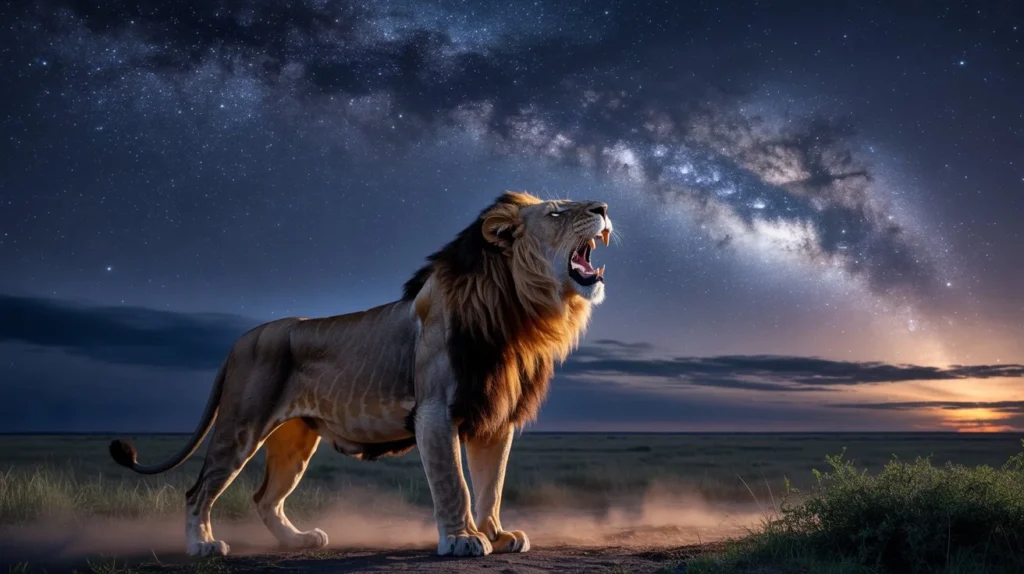
The male lion’s famous roar audible up to 8 kilometres away is not mere theatrics. It is a territorial broadcast that warns rival males, signals coalition strength, and actively deters potential threats to the pride. Research by Jon Grinnell at the Lion Center found that resident males will even approach intruders when outnumbered, a near-suicidal willingness driven by the reproductive stakes of protecting their bloodline.
This territorial defence is a form of paternal investment that operates continuously, day and night, regardless of whether the male is resting or active. Every border scent-marked, every intruder challenged, every roar echoed across the savanna is, in biological terms, an act of fatherhood.
Moments of Tenderness: When Male Lions Show Affection
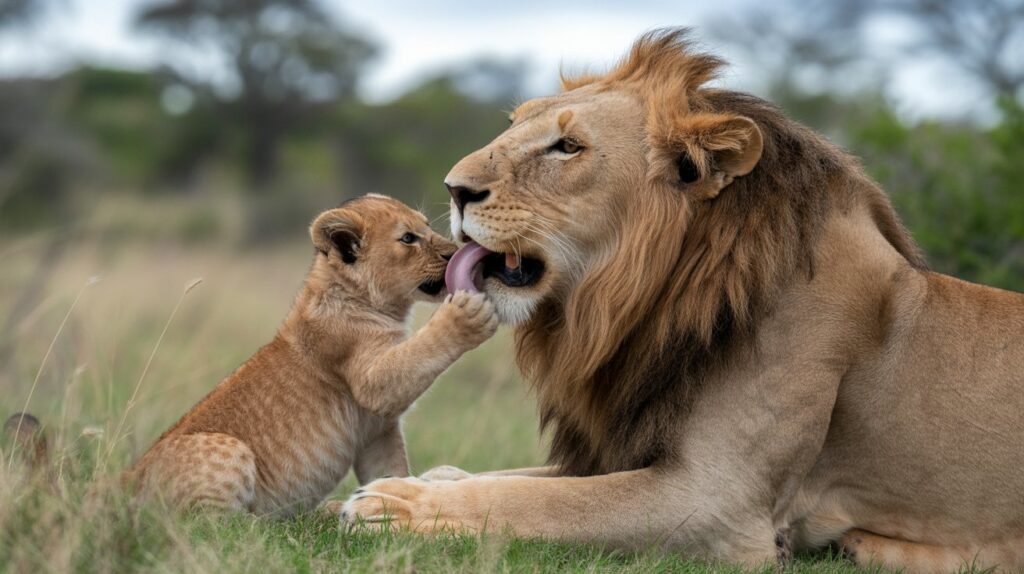
Beyond protection and territory, male lions do display notable moments of warmth and engagement with their cubs behaviours that are easy to miss on a single safari game drive but are well-documented by field researchers.
- Grooming: Male lions are occasionally observed licking and grooming their cubs, reinforcing social bonds and providing comfort, particularly within stable, undisturbed prides.
- Play: Cubs frequently initiate play with their fathers tugging at manes, pouncing on tails and males often tolerate this with remarkable patience, occasionally engaging in gentle roughhousing.
- Vocalisation: Males use soft grunts and low vocalisations to communicate with cubs, and young lions quickly learn to recognise their father’s voice, building familiarity and trust.
- Social mentorship: By observing their fathers, cubs learn critical social skills dominance cues, coalition dynamics, how to read the behaviour of other lions. These lessons shape their survival as adults.
East African lion populations particularly those studied in the Serengeti and Maasai Mara show the highest levels of male-cub interaction, likely due to stable prey populations and well-established territorial ranges. This is one of many reasons a safari to these iconic landscapes offers such rich wildlife encounters.
The Dark Side: Infanticide and the Absent Father Narrative
No honest account of lion fatherhood can avoid the disturbing reality of infanticide. When a new male coalition displaces resident males, the surviving cubs of the ousted fathers face near-certain death. Incoming males are unwilling to invest energy in cubs that carry another male’s genes, and their reproductive clock with a tenure of roughly two years before being displaced themselves creates intense pressure to sire offspring immediately.
This behaviour has understandably fuelled the narrative of male lions as poor parents. But it is important to distinguish between the behaviour of a resident father and that of an invading male. A male lion that has sired cubs and holds tenure over a pride is not the same animal as a coalition in the process of conquest. The former is a protector; the latter is a competitor.
Contextual fatherhood matters. When male lions are asked to be fathers when they hold a stable pride, know their cubs, and have time to form bonds the evidence shows they do protect, tolerate, and in their own way, nurture.
Male Lions vs. Other Big Cat Fathers: A Brief Comparison
Placing male lion paternal behaviour in context makes their contribution even more significant. Among the big cats:
- Tigers are entirely solitary; male tigers have no interaction with their cubs whatsoever.
- Leopards occasionally engage in brief play with cubs but provide no sustained protection.
- Jaguars and cougars show minimal to no paternal involvement.
- Lions are the only big cat species where males provide significant, long-term paternal protection to their offspring.
By this measure, the male lion is not just a good father by mammalian standards he is an exceptional one by feline standards.
Conservation Implications: Why Protecting the Males Matters
Understanding male lion paternal behaviour has real implications for wildlife conservation in Africa. When trophy hunting, poaching, or human-wildlife conflict removes dominant males from a pride, the vacuum they leave is swiftly filled by rival coalitions. The resulting wave of infanticide can devastate a pride’s cub population in days, setting back local population recovery by years.
This is one reason wildlife conservationists increasingly argue for the protection of entire pride structures not just the headline-grabbing individuals, but the coalition males whose quiet, territorial presence keeps cubs alive. Sustainable safari tourism, which funds conservation efforts across Kenya, Tanzania, Botswana, and South Africa, plays a direct role in maintaining these structures.
Comparing Male Lion Parenting to Other Species
Male lion parenting is unique but varies greatly compared to other animals in the wild. While male lions focus on protection and territory defense, other species show different levels of paternal care ranging from total absence to full hands-on involvement. This comparison helps put male lions’ role in perspective within the diverse world of animal fatherhood.
| Species | Male Parenting Role | Level of Involvement | Key Behaviors | Impact on Offspring Survival |
| Male Lions | Protector and stabilizer | Moderate | Defend territory, deter rival males, occasional grooming and bonding | Provides safety and stability, reduces infanticide risk |
| Tigers | Minimal to none | Low | Solitary males, no direct care or protection | Cubs rely solely on mother for care and protection |
| Leopards | Minimal to none | Low | Males do not participate in raising cubs | Cubs depend entirely on mother’s protection |
| Emperor Penguins | Active father and incubator | Very High | Male incubates eggs for months, protects chicks | Critical for chick survival in harsh environments |
| Seahorses | Primary caregiver | Very High | Males carry and nurture developing young in brood pouch | Directly responsible for offspring development |
| Wolves | Cooperative parents | High | Males help hunt, feed, and protect pups | Improves survival through shared parental duties |
| Elephants | Supportive but less direct | Moderate | Males protect herd boundaries and maintain social order | Indirect support through protection and leadership |
When you see a male lion resting under an acacia on your African safari, remember: he was likely patrolling that same territory until dawn, keeping threats at bay so his cubs could sleep.
The Verdict: Are Male Lions Good Fathers?
The answer is a qualified but genuine yes with important context. Male lions do not parent in the warm, hands-on way that many mammals do, and the reality of infanticide during pride takeovers is a stark reminder of nature’s indifference to sentiment. But within the framework of their own ecology and social structure, resident male lions make profound contributions to the survival of their offspring.
They patrol borders. They repel rivals. They absorb the risk of confrontation so their cubs do not have to. They tolerate the playful ambushes of their young, rumble low vocalisations of reassurance, and in extreme documented cases, have even protected cubs alone when lionesses are absent. The male lion’s fatherhood is expressed in the language of survival and in the African wilderness, that is the only language that truly counts.
Plan Your Safari: See Lion Pride Behaviour in the Wild
There is no better way to understand the complex dynamics of lion fatherhood than to witness a pride in action. Africa Wild Safaris offers expertly guided wildlife experiences across the Serengeti, Maasai Mara, Okavango Delta, and Kruger National Park each home to thriving lion populations and world-class wildlife guides who bring animal behaviour to life.
Whether you are watching a coalition male in full roar at dusk or spotting cubs tumbling over their resting father in the early morning light, every moment on safari adds depth to your understanding of these extraordinary animals.
Contact Africa Wild Safaris today to plan your African wildlife safari and discover the truth about lion family life up close, in context, and unforgettably.
Frequently Asked Questions:
Are Male Lions Good Fathers?
Expert answers backed by field research — for wildlife enthusiasts and safari travellers.
Ready to witness lion fatherhood in the wild?
Plan Your Safari