



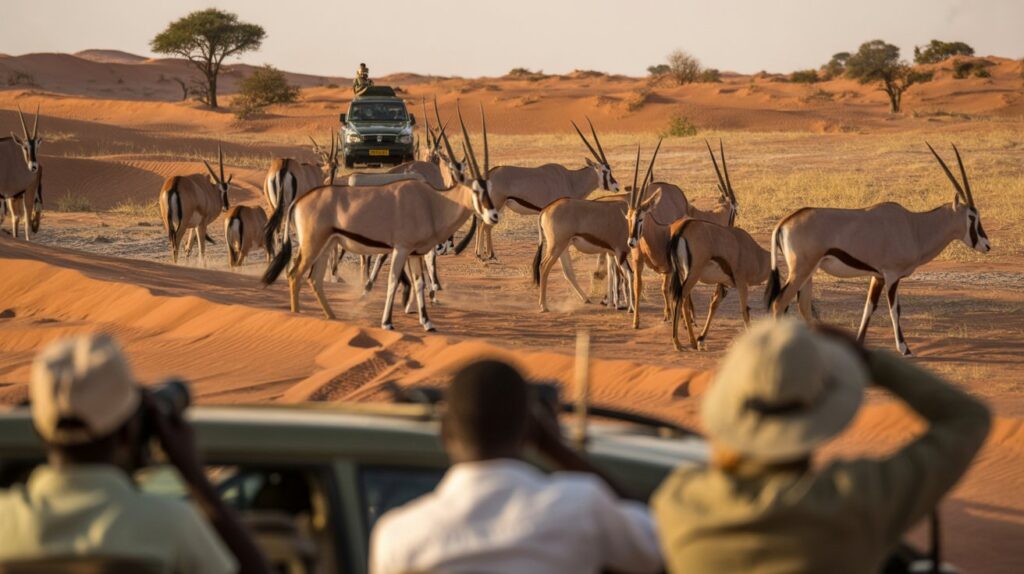
Every week, travellers ask us some version of the same question: “Is Namibia Namibia Good for Safari, or should I go to Kenya?” It is one of the most important questions we get, because the honest answer is nuanced. Namibia is extraordinary. It is also genuinely unlike any other safari destination in Africa. Getting that distinction wrong leads to disappointment; getting it right leads to one of the most unforgettable journeys of your life.
This guide is our straightforward answer — covering wildlife, landscape, logistics, costs, the best regions, when to go, and exactly who Namibia is (and is not) right for.
Also: Trips Beyond: Safari Experiences That Transcend Expectation
What Makes a Namibia Safari Different
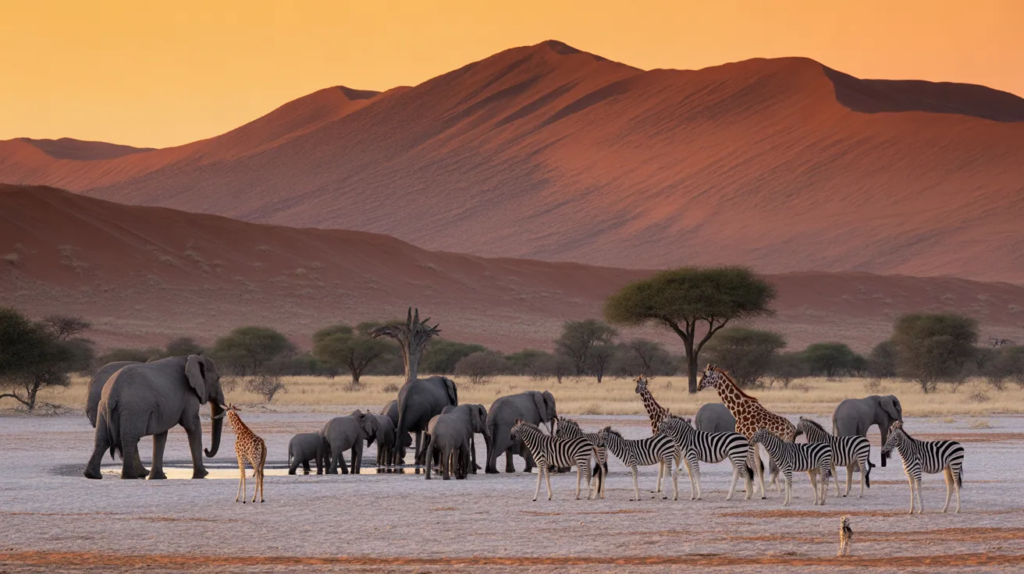
Namibia sits on Africa’s southwest coast and is one of the least densely populated countries on the planet. Roughly a fifth of its entire landmass is protected, yet the safari experience here is shaped not by lush savannah teeming with herds, but by desert, silence, and scale. The Namib Desert is the oldest on Earth. The dunes at Sossusvlei tower over 300 metres. The Skeleton Coast is a haunting, fog-draped wilderness of shipwrecks and seal colonies. Etosha’s salt pan stretches so far it looks like snow.
You go on safari in Kenya to chase the Big Five. You go on safari in Namibia to see something truly, often startlingly, different.
The wildlife here has had to adapt to one of Earth’s harshest environments. Namibia’s desert-adapted elephants are a recognised sub-population that have evolved to cover vast distances without water — a sighting that carries a weight no savannah elephant encounter can fully replicate. The country is also home to the largest free-roaming black rhino population in Africa, and holds the world’s highest concentration of cheetahs. These are not consolation prizes. They are rare, meaningful encounters.
Top Safari Regions in Namibia
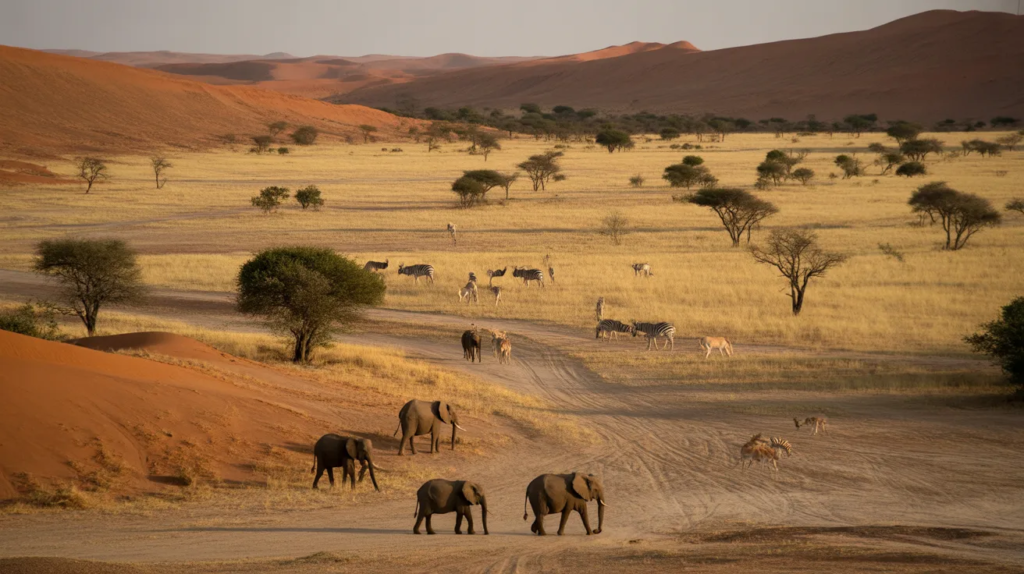
Namibia is vast — nearly twice the size of California. Understanding where to go is essential to planning an itinerary that works.
Namibia — Five Regions
A safari reference guide to the country’s most important wildlife destinations
| # | Region | Type | Highlight | Key Wildlife | Self-Drive |
|---|---|---|---|---|---|
| 01 |
Etosha National Park
North Namibia
|
Wildlife | 22,000 km² salt pan with floodlit waterholes. Four of the Big Five reliably seen. |
Lion
Elephant
Black Rhino
Giraffe
Cheetah
|
✓ Yes |
| 02 |
Damaraland
Northwest
|
Wilderness | Ancient riverbeds & Twyfelfontein rock engravings (UNESCO). Most underrated region. |
Desert Elephant
Black Rhino
|
✓ Yes |
| 03 |
Skeleton Coast
Atlantic Coast
|
Coastal | Shipwrecks, whale bones & 100,000+ Cape fur seals on a fog-shrouded coastline. |
Brown Hyena
Cape Fur Seal
Seabirds
|
Limited |
| 04 |
Sossusvlei & NamibRand
South Namibia
|
Desert | Iconic red dunes & Deadvlei clay pan. Africa’s only Gold Tier Dark Sky Reserve. ★ |
Oryx
Springbok
|
✓ Yes |
| 05 |
Zambezi Region
Northeast
|
Wetland | Lush & water-rich, borders Chobe (Botswana). A completely different safari — often overlooked. |
Hippo
Crocodile
Buffalo
Birds
|
✓ Yes |
The Honest Pros & Cons of a Namibia Safari
Most travel content tells you only the positives. Here is the full picture.
Namibia — Pros & Cons
| ✓ Why Namibia Works | ✗ Where Namibia Falls Short |
|---|---|
| ✅Largest free-roaming black rhino population in Africa | ❌Lower overall wildlife density than Kenya, Tanzania, or Botswana |
| ✅World’s highest cheetah density — real sighting chances | ❌Buffalo absent from Etosha (only in the Zambezi Region) |
| ✅Desert-adapted elephants: a truly unique subspecies | ❌No Great Migration or comparable mass wildlife spectacle |
| ✅Excellent self-drive infrastructure and safe roads | ❌Vast distances demand 10–14 days minimum |
| ✅Low tourist density — often the only vehicle at a sighting | ❌Desert heat extreme Nov–Mar; some roads impassable |
| ✅NamibRand: Africa’s only Gold-Tier Dark Sky Reserve | ❌Leopard sightings rare compared to South Africa’s Sabi Sand |
| ✅Community conservancy model among Africa’s best | ❌Limited flights mean longer international travel times |
| ✅More affordable than Botswana; good value across budget tiers | ❌Leopard sightings are rare compared to South Africa’s Sabi Sand |
Best Time to Visit Namibia for Safari
Namibia — Best Time to Visit
| May – Oct Dry Season — Peak Safari | Jun – Sep The Sweet Spot | Nov – Apr Green Season |
|---|---|---|
| Wildlife congregates at waterholes. Clear skies and excellent photography. Nights near freezing — pack layers. Book well in advance; this is high season. | Moderate 23°C daytime temperatures. Etosha waterholes at their most active. Optimal for game drives, stargazing, and rhino tracking in Damaraland. | Lower prices, fewer crowds, migratory birds, and newborn animals. Some roads impassable after heavy rains. The Namib blooms briefly — a rare spectacle. |
| Clear skies, peak wildlife, book early, cold nights | Clear skies Peak wildlife, book early Cold nights | 23°C days, Best game drives, Stargazing, Rhino tracking |
Namibia vs Kenya vs Botswana: Which Is Right for You?
Choose Namibia if…
You want a safari that is as much about landscape and journey as it is about game drives. If you are a photographer, a repeat safari-goer looking for something genuinely different, a couple seeking seclusion, or a traveller drawn to self-drive adventure, Namibia is hard to beat. Its private conservancies can leave you entirely alone in the wilderness for hours at a time — a rarity on the African continent.
Choose Kenya or Tanzania if…
You are a first-time safari visitor whose primary goal is maximum wildlife volume — particularly the Great Migration, big cat density, and classic savannah game drives. The Maasai Mara and Serengeti deliver a sheer concentration of animals that Namibia’s desert ecosystem simply cannot match. That is not a failing; it is a different product entirely.
Choose Botswana if…
You want a remote, waterway-based, ultra-exclusive experience with high animal diversity and pristine wilderness. Botswana’s Okavango Delta offers mokoro rides, the largest elephant population on Earth, and exceptional wild dog sightings — but at a significantly higher price point. Namibia is considerably more accessible and budget-flexible.
Many experienced safari-goers combine Namibia with Botswana or Zimbabwe into a 2–3 week Southern Africa circuit — using each country’s strengths to build a complete picture of the continent’s safari offering.
What Type of Safari Works Best in Namibia?
Self-Drive Safari
Namibia is one of the continent’s finest self-drive safari destinations. Roads are well-maintained, signage is clear, and in Etosha, you can explore entirely at your own pace in a standard 2WD vehicle (a 4×4 is recommended for Damaraland and the Skeleton Coast). Rental vehicles are widely available from Windhoek and Walvis Bay.
Fly-In Safari
For those with limited time or who want to cover Namibia’s vast distances efficiently, a fly-in safari turns transfers into aerial safaris over the dunes and salt pans. This is the preferred approach for the Skeleton Coast and remote Damaraland lodges.
Guided & Luxury Safari
Private guides unlock depth — knowing where the desert-adapted rhino were tracked last week, how to read lion prints on a dry riverbed, which waterhole lights up at dusk. Some of Namibia’s finest lodges — from Sossusvlei’s dune hideaways to intimate Damaraland camps — are among the best on the continent. Expect rates from $350 to $1,500+ per person per night at high-end properties.
Namibia Safari Wildlife: What to Realistically Expect
Etosha reliably delivers lion, elephant, black and white rhino, giraffe, cheetah, zebra, oryx, springbok, and kudu, as well as over 340 bird species. The floodlit waterhole at Okaukuejo Rest Camp is one of Africa’s great free wildlife experiences — black rhino arrive predictably at dusk, and you simply sit and watch.
In Damaraland, desert-adapted elephants and rhinos are tracked on foot with expert guides. Along the Skeleton Coast, the Cape fur seal colonies are spectacularly large, and brown hyena, bat-eared foxes, and aardwolves are encountered with patience. The Zambezi Region adds hippo, crocodile, and buffalo, completing a picture that — spread across the country — is richer and more varied than a single park’s density might suggest.
So, Is Namibia Good for Safari? Our Final Word
Namibia is not just good for safari — for the right traveller, it is exceptional. It will not give you the wall-to-wall wildlife of the Serengeti. What it gives you instead is silence, space, encounters that feel genuinely wild, and landscapes that make you feel you have landed on another planet.
The desert-adapted elephants of Damaraland, the black rhinos of Etosha, the billion stars above NamibRand — these are experiences that lodge permanently in memory.
If you are looking for a safari that challenges your idea of what a safari can be, Namibia belongs at the top of your list. If you are after your first-ever game drive and want guaranteed big cat sightings and herds of wildebeest, go to Kenya or Tanzania first — then come to Namibia when you are ready for so