



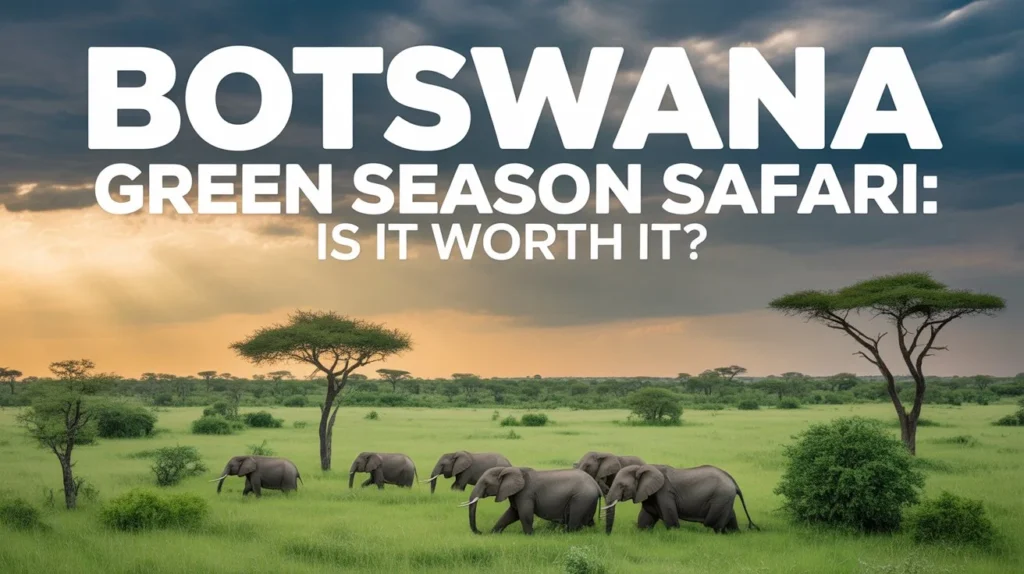
Most travelers picture Botswana in the dry season: golden light, dusty riverbeds, lions sprawled beneath fever trees with all the ease of creatures who own the world. But there is another Botswana, one that fewer people ever witness. From November through April, the rains transform the Okavango Delta and the Kalahari into something almost unrecognisably alive. And for the right kind of traveler, it is nothing short of extraordinary.
The green season in Botswana has a reputation problem. Somewhere along the way, “wet season” became code for “avoid it.” But those who have watched a thunderstorm roll across the Makgadikgadi Pans at golden hour, or tracked a breeding herd of elephants through chest-high emerald grass, know that the real question is not whether to go, but whether you’re ready for something that exists outside the ordinary safari script.
This article breaks down exactly what a Botswana green season safari looks, feels, and costs like. Who it suits. What wildlife you can genuinely expect. And whether the trade-offs are worth it for your particular trip and travel personality.
Is a Botswana Green Season Safari Worth It?
The short answer is yes, but with important caveats. The green season, broadly November through April with the heaviest rains falling between January and March, offers a genuinely different safari experience from the peak dry months. Rates at premier camps drop by 25–40%. The landscape becomes cinematic. Wildlife activity is surprisingly high, just distributed across a lusher, wider terrain.
The caveat is simple: if your primary goal is dense, concentrated wildlife viewing, the dry season delivers that reliability more consistently. But if you’re drawn to photographic drama, world-class birding, newborn animals, and genuine solitude in one of Africa’s most extraordinary landscapes, the green season rewards you in ways the dry season simply cannot.
What Actually Changes in Botswana’s Green Season
The Landscape Transforms Completely
By late November, the first rains have already begun reshaping Botswana. The Kalahari, which spends most of the year as a semi-arid scrubland of red sand and sparse thorn, erupts into grasses and wildflowers seemingly overnight. The Okavango’s seasonal floodplains fill with standing water. And the sky, arguably Botswana’s most underrated feature, becomes alive with towering cumulonimbus clouds that glow in afternoon light like something pulled from a Renaissance painting.
Even the Chobe River corridor takes on a different character entirely. The riparian forest grows dense and layered. Animals move with a different energy, less concentrated around water sources, spread across the terrain in ways that feel ancient and free. You are no longer watching wildlife queue at a waterhole. You are entering their world.
“The green season is when Botswana stops looking like a postcard and starts feeling like a living, breathing ecosystem, wild and ancient in exactly the right ways.”
Wildlife Behaviour Shifts in Fascinating Ways
Here is what surprises most travelers: wildlife does not disappear in the green season. It disperses. Predators, lions, leopards, cheetahs, African wild dogs, are still hunting, still territorial, still extraordinary to observe. You will find them in thicker vegetation, which demands sharper eyes and a better guide. This is precisely where the quality of your camp and guiding team becomes everything.
Newborn animals are everywhere. Impala, zebra, wildebeest, warthog, and elephant calves all arrive in significant numbers during these months, a deliberate evolutionary alignment with peak food abundance. Predators know this too, which means action, while less predictable, is rarely absent.
The Hidden Advantages Most Travel Agents Won’t Tell You
Birding That Belongs on a Life List
Botswana in the green season is, quite simply, one of the great birding destinations on earth. Migratory species pour in from Europe and Asia: carmine bee-eaters, European rollers, broad-billed rollers, saddle-billed storks, and raptors in numbers that serious birders travel continents to witness. The Okavango in particular hosts an extraordinary diversity of waterbirds, from the iconic African fish eagle to the rarely photographed slaty egret.
Even if you have never considered yourself a birder, watching a colony of carmine bee-eaters in full flight, hundreds of flame-red and turquoise birds hovering over the waterways at dusk, tends to convert people quickly and permanently.
Photographic Light That Is Simply Unmatched
The quality of light during Botswana’s green season is something photographers discuss in reverent terms. Dramatic storm-light at golden hour. Perfect reflections across the flooded Makgadikgadi. Elephants silhouetted against bruised purple skies as lightning cracks somewhere in the distance. The green landscape provides a backdrop that makes every wildlife image feel layered and alive, quite different from the golden-dust aesthetic of the dry season.
Dry Season: May to October
- Concentrated wildlife at waterholes
- Sparse vegetation for easy sighting
- Golden light, classic aesthetic
- High predictability for big cats
- Peak pricing and visitor numbers
- Best for first-time safari travelers
Green Season: November to April
- Active, dispersed wildlife
- Lush landscape & dramatic skies
- Newborn animals everywhere
- World-class birding at its peak
- 25–40% lower camp rates
- Best for photographers & repeat visitors
What to Expect Day-to-Day on a Green Season Safari
A typical green season day in Botswana begins the same as any other safari day: an early wake-up before dawn, coffee in the dark, and a game drive before the heat builds. The key practical difference is that afternoon activities sometimes pause briefly during short, intense rain showers. Most experienced camps schedule around these, and the best guides use rainfall to their advantage, as predators move and hunt readily in wet conditions.
Mokoro excursions in the Okavango, those impossibly quiet pole-propelled canoe trips through lily-covered channels, are often at their most spectacular during the green season, when water levels are high and the waterways feel genuinely endless. Sundowners beside swollen rivers, dinners accompanied by the sound of distant thunder rolling across the floodplains, these become part of the natural rhythm of your trip.
- Best months for birding: November through March
- Peak rains: January and February, short afternoon showers, rarely all-day
- Best wildlife areas: Okavango Delta, Chobe, Linyanti & Kwando concessions
- Expect: Newborns, dispersed predators, dramatic photography, outstanding value
- Pack: Light layers, rain jacket, insect repellent, neutral-coloured clothing
- Ideal for: Photographers, birders, repeat safari guests, honeymooners
- Avoid if: Concentrated big-cat sightings at waterholes is your singular priority
How to Plan a Green Season Botswana Safari
The most important decision is choosing the right camps, as not all Botswana properties are equally well-suited to green season travel. The Okavango Delta’s private concession camps, particularly in the Moremi Game Reserve surrounds, remain excellent year-round. Linyanti and the Kwando River concessions are extraordinary during this period, with elephant concentrations and wild dog activity that rival anything the dry season produces.
Combine three to four camps strategically, mixing water-based mokoro and motorboat activity in the Delta with land-based game drives in Chobe or the Central Kalahari, and you build a trip that tells a complete story of Botswana’s ecosystems at their most alive and dynamic.
At Africa Wild Safaris, we have guided guests through Botswana in every season across four generations of Kenyan family experience. The green season itineraries we build tend to be some of our most memorable: smaller groups, more intimate camps, and the kind of unscripted wildlife encounters that become the stories you tell for the rest of your life. Explore our Botswana safari experiences to see what we have planned for the season ahead.
The green season does not ask you to settle for less. It asks you to look differently: more carefully, more patiently, more curiously.
Botswana in the rains is a place where flamingoes turn salt pans pink, where lion cubs learn to stalk in long grass under a gunmetal sky, and where a single thunderstorm at sunset makes every dry-season photograph you have ever seen feel somehow incomplete.
The green season is not Botswana’s secret. It is simply Botswana for those who are ready for it.
Plan My Green Season Safari →