



When Is the Best Time?
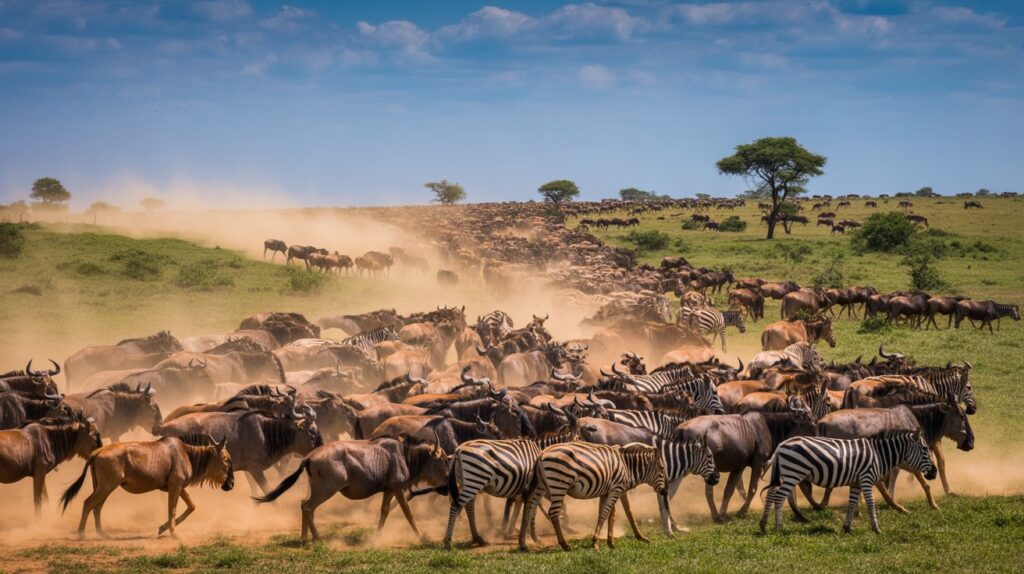
The best overall time to see the Great Migration is July through October, when over 1.5 million wildebeest storm the Masai Mara and face the iconic Mara River crossings. However, every month of the year offers a distinct and extraordinary phase of the migration. Your ideal time depends on what you want to see most — river crossings, mass calving, or vast columns of marching herds.
The Great Wildebeest Migration is one of those rare natural events that stops seasoned safari veterans in their tracks. Over two million animals — wildebeest, zebras, and gazelles — move in a continuous, clockwise loop across the Serengeti-Mara ecosystem in Tanzania and Kenya, driven purely by rainfall and the instinct to survive. There is no start date, no finish line, and no guarantee of what you will witness. That unpredictability is precisely what makes it so extraordinary.
At Africa Wild Safaris, we have guided guests through every phase of this migration for decades. This guide breaks down each month, tells you where the herds are, what they are doing, and — most importantly — whether that is the right moment for your safari.
Also Read: Safari Animals in South Africa: A Complete Guide
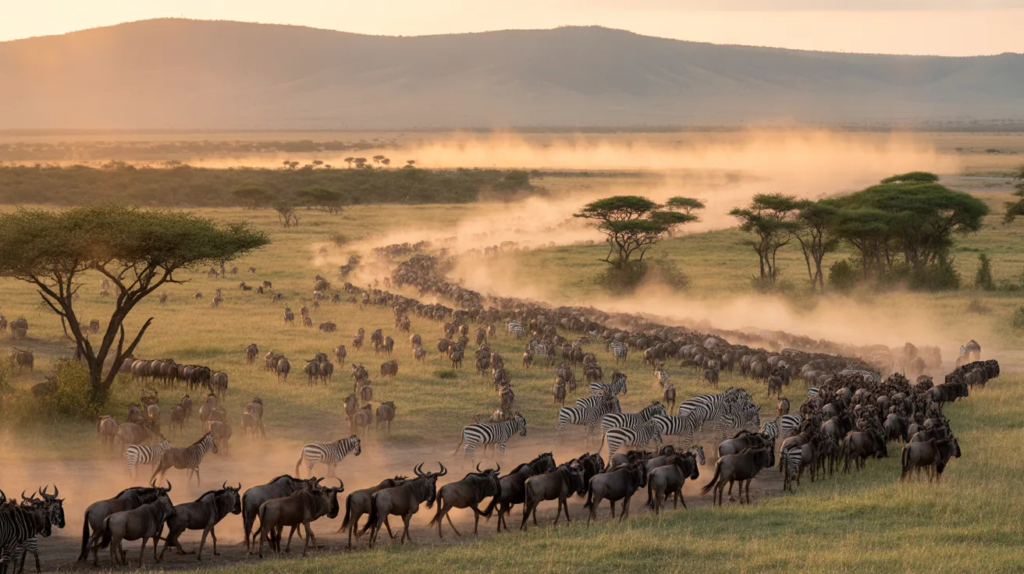
Great Migration at a Glance: Month-by-Month Overview
Great Migration — month-by-month overview
| Month | Location | Key spectacle | River crossings | Crowds |
|---|---|---|---|---|
| Jan – Feb | Southern Serengeti / Ndutu | Peak calving season | None | Low |
| Mar – Apr | Southern → Central Serengeti | Herds moving north | None | Very Low |
| May – Jun | Western Corridor / Grumeti | Herds spread across the Mara | Grumeti River | Low |
| Jul – Aug | Northern Serengeti / Masai Mara | Mara river crossings begin | Mara River (peak) | Very High |
| Sep – Oct | Masai Mara / Northern Serengeti | Return south after the rains | Mara River (ongoing) | High |
| Nov – Dec | Serengeti (heading south) | Return south after rains | Southward crossings | Low |
Month-by-Month Migration Guide
January & February — Calving Season | Southern Serengeti & Ndutu Plains
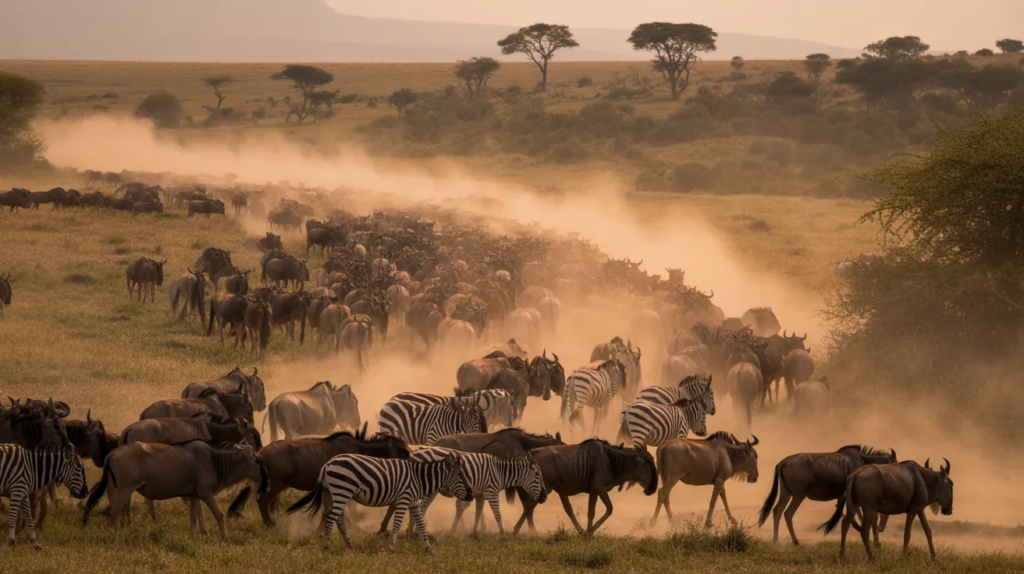
The southern Serengeti transforms into the world’s greatest nursery. Over 500,000 calves are born within a compressed three-to-four-week window, with February seeing the highest daily birth rate — sometimes more than 8,000 newborns in a single day. The volcanic soils of Ndutu produce nutrient-rich short grasses perfectly suited to nursing mothers. Predator activity — lions, cheetahs, leopards — is intense, drawn by the abundance of vulnerable calves. For wildlife photographers, this is one of the most dramatic and emotional experiences on the planet.
March & April — Green Season | Central Serengeti — The Long March Begins
Calves grow stronger, and the vast columns begin their northward push. Herds stretch up to 40 kilometres long, threading through the Central Serengeti past the Simba Kopjes and Moru area. The long rains make roads tricky, but the landscape explodes with colour. Crowds are minimal, prices drop, and you will often have entire landscapes to yourself — a secret season for discerning travellers.
May & June — Grumeti Crossings | Western Corridor — The First River Gauntlet
The herds bottleneck at the Grumeti River in the Western Corridor — their first major obstacle. While less dramatic than the Mara crossings, these scenes are still electric. Massive crocodiles await in the pools. June marks the end of the long rains, vegetation thins out, and wildlife becomes easier to spot. This is an underrated window: the action is genuine, the camps are quieter, and the light for photography is often exceptional in the early mornings.
July & August — Peak Season | Mara River — The Most Spectacular Crossings on Earth
This is the moment most people dream about. From late July, the first herds reach the Mara River — a crocodile-filled torrent separating Tanzania from Kenya’s Masai Mara. Over 3,000 Nile crocodiles wait in the murky water as panicked wildebeest plunge from high riverbanks in a thundering, chaotic rush. August is widely regarded as the single best month for river crossing sightings. Book your camp as close to the river as possible — ideally near Kogatende or the Mara Triangle — and plan to wait. Crossings can happen multiple times a day, or not at all for days; the unpredictability is half the magic.
September & October — Masai Mara Peak | Herds Spread Across Kenya’s Plains
September sees the bulk of the herds spread across the open Masai Mara, enjoying the dry plains and excellent grazing. Big cat sightings are world-class at this time — lions, cheetahs and leopards hunting across vast, open savannah. Crossings continue both northward and southward across the Mara River. By October, the short rains begin, and the herds start their return journey south. Staying in a private conservancy bordering the Masai Mara gives you exclusive access away from the peak-season vehicle congestion.
November & December — Return South | Serengeti — The Quiet Return
Short rains trigger a rapid dispersal south through the Lobo area and into the Eastern Serengeti. The movement is less concentrated but covers vast distances quickly. By December, the herds begin arriving back at the southern Serengeti and Ndutu, ready to rest on the lush short-grass plains before the calving cycle begins again in January. Accommodation prices fall in the Mara, and this underrated window in northern Tanzania offers atmosphere, solitude, and surprisingly excellent game viewing.
The Mara River Crossing: What You Need to Know
No moment in wildlife safaris is more requested — or more unpredictable — than the Mara River crossing. The herds gather on the southern bank in their thousands, building up courage (or instinct) before plunging into waters thick with one of the densest concentrations of Nile crocodiles on Earth. Then, in a moment of collective madness, they leap.
Insider Tips for Witnessing a River Crossing
- Stay close to the river. Choose a camp within 30 minutes of the Mara River crossing points — Kogatende, Lamai Wedge, or the Mara Triangle. Driving time to the action matters enormously.
- Plan for patience. Herds may gather and then retreat for days before crossing. A minimum of 4-6 nights greatly increases your chances.
- Go in August for peak crossings. Mid-July to late August typically sees the most dramatic and frequent crossings.
- Consider a mobile camp. Camps that reposition with the migration put you in the right place as the herds move.
- Book 12-18 months in advance. Prime river-adjacent camps for July-September sell out over a year ahead.
The Calving Season: Africa’s Most Tender Spectacle
While river crossings get the headlines, many experienced safari travellers argue that the calving season is the more profound experience. Between late January and mid-March, over 80% of fertile female wildebeest give birth within a few weeks of each other — a phenomenon driven by synchronised gestation evolved to overwhelm predators with sheer numbers.
The Ndutu plains in the southern Serengeti, fertilised by ancient volcanic ash from the Ngorongoro Crater, produce the short, mineral-rich grasses that make this the perfect nursery. Within minutes of birth, a calf is on its feet. Within an hour, it can run. Witnessing this cycle of birth, predation, and survival — with lions, cheetahs and wild dogs hunting continuously across the plains — is one of the most emotionally affecting experiences that Africa offers.
Insider Tip: To witness actual wildebeest births, plan game drives around midday — females typically give birth during daylight hours to maximise the calf’s chances of gaining strength before nightfall. The Ndutu Conservation Area and the Kusini plains offer the most accessible and concentrated calving grounds.
When Is the Absolute Best Time?
For River Crossings — July to August
If witnessing wildebeest hurtling into crocodile-filled waters is your primary goal, target late July through August and position yourself at the Mara River. August is, by wide consensus among guides and operators, the single most reliable month for dramatic crossing action.
For Big Cat Action & Quieter Herds — September
September offers everything August does — vast herds, ongoing crossings, spectacular predator-prey encounters — but with slightly fewer safari vehicles. Staying in a Masai Mara conservancy rather than the main reserve elevates the experience further.
For Calving Season Photography — January to February
February is peak calving, with up to 8,000 wildebeest born daily on the Ndutu plains. It is one of Africa’s most tender and dramatic wildlife experiences, combined with intense predator action. Lower prices and fewer crowds than peak season make this an exceptional value.
For Budget-Conscious Travellers — May to June or November
The Grumeti crossings in June are genuinely spectacular and underrated. November’s quiet return south through the Serengeti offers solitude and atmosphere. Both windows come with significantly lower lodge rates.
Frequently Asked Questions
Is the Great Migration visible year-round?
Yes. The Great Migration is a continuous, year-round event — there is no ‘off season.’ The herds are always moving somewhere within the Serengeti-Mara ecosystem. What changes month to month is the location, the phase of the cycle, and what you will witness.
Can the river crossings be guaranteed?
No — and this is crucial to understand before booking. River crossings are driven entirely by the wildebeest themselves and the rains. They can occur multiple times in a single day or not at all for a week. Staying longer (minimum 4-6 nights near the river) significantly increases your chances.
Where is better for the migration — Serengeti or Masai Mara?
For river crossings from July to September, the Masai Mara (Kenya) or Northern Serengeti (Tanzania) are both excellent. Tanzania’s Kogatende area offers a more exclusive, less-crowded experience. The Masai Mara is larger in terms of open savannah, but can see significant vehicle congestion in peak season. For calving season, the Southern Serengeti and Ndutu are unbeatable.
How far in advance should I book a migration safari?
For the peak July-September window, book 12 to 18 months in advance, especially for camps close to the Mara River crossing points. These sell out faster than any other safari product in Africa. For calving season and the green season, 6-9 months is generally sufficient.
How many animals are in the Great Migration?
The migration involves approximately 1.5 million wildebeest, along with around 400,000 zebras, 12,000 eland, and 300,000 Thomson’s and Grant’s gazelles — making it the largest terrestrial mammal migration on Earth.